Build a Warehouse Plan Your Floor Can Actually Survive
Every warehouse plan hides one fragile assumption. Use this five-question survivability check and walk-burden data to build a plan your floor can hold.
Labor is 65 to 70 percent of warehouse operating costs. Most of that labor gets planned on a spreadsheet the night before, under one invisible assumption: that the floor will behave the way the model expects it to.
It almost never does.
A truck arrives 90 minutes late. A fast mover is not where the model expected it. The dock gets tight. A reserve location had bad inventory. One unusual order pattern shifts the pick path for half the morning wave. The plan may still look efficient on paper, but once the first real constraint hits, it stops being useful.
That is the gap between a theoretically optimal plan and an operationally survivable one. Optimal is a single answer. Survivable is a plan your floor can absorb when reality shows up.
Every clean plan hides one fragile assumption
The problem is not that warehouse planners optimize too aggressively. The problem is that most planning tools do not show which assumption is holding the plan together.
Maybe the plan requires receiving to finish before wave release. Maybe it assumes the highest-velocity picker is on the route. Maybe it counts on overflow staying out of the main aisle. Maybe it needs reserve inventory accurate enough to feed replenishment on time.
Those assumptions are not automatically wrong. The issue is that they are invisible. The plan looks clean right up until it does not, and the warehouse finds out the hard way which assumption was carrying it.
Consider how often these specific conditions quietly break a plan:
- Dock timing slips and a staged replenishment wave fires before the forward pick face is ready
- A SKU velocity spike pulls volume from a slow-mover location that is nowhere near the start point
- A supervisor is pulled to handle an inbound exception and the floor loses the person who knew where the edge cases lived
- Carton data is wrong for an import container and the putaway plan collapses before the first pallet is touched
Each of those is a single-point failure. The plan had no way to hold if that one thing broke. A survivable plan either removes the single point or already knows the cost when it breaks.
The right question is not "what is most efficient?"
Efficiency is the wrong target when conditions are unstable. The better question is: which inefficiency can we survive?
That sounds less impressive. It is closer to how warehouses actually run.
A practical plan chooses where the operation is willing to pay. None of these tradeoffs are free. The difference between a survivable plan and a fragile one is whether the cost is visible before the shift starts or discovered after the floor is already behind.
| Tradeoff | What it protects | What it costs |
|---|---|---|
| Extra staging lanes near receiving | Dock flow, order timing | Floor space, extra touches |
| Longer travel for the first week | Inventory visibility, accuracy | Picker hours |
| Delayed slotting moves | Stable pick paths during transition | Temporary suboptimal placement |
| Buffer inventory at forward pick | Service level, replenishment flexibility | Storage pressure, cash |
| Split shipments | Customer promise on partial stock | Freight, coordination overhead |
| Manual exception check on top SKUs | Wave continuity | Supervisor attention |
The point is not to avoid all of these. It is to choose deliberately instead of discovering the cost mid-shift.
A real example with numbers
A warehouse transitions from parcel shipping into container imports and case fulfillment. The perfect plan: receive the container, putaway pallets to reserve, replenish forward pick locations, ship cases from the active zone.
That sequence only works if dock timing is stable, carton data is clean, forward pick space is ready, and volume is predictable enough that replenishment does not fall behind demand.
In a new flow, those four things are rarely all true at the same time.
The survivable version of the same plan makes three deliberate choices:
Choice 1: Add two extra staging lanes near the dock. Cost: roughly 400 square feet of floor space for three to four weeks. Benefit: the dock can absorb a two-hour delay without blocking inbound flow or stalling wave release.
Choice 2: Accept 15 to 20 percent longer travel for the first two weeks. Cost: estimated 45 extra minutes per picker shift during transition. Benefit: all new inventory stays in a visible, confirmed zone before being committed to forward pick locations.
Choice 3: Hold slotting moves on the top 30 SKUs until actual case demand is clear. Cost: suboptimal placement for high-velocity items during the transition period. Benefit: avoids two rounds of reslotting when demand comes in differently than the model predicted.
That plan looks less efficient. It is also the one the team can execute without a supervisor pulling everything together in real time.
The five-question survivability check
Before your next wave plan or slotting move, run through these:
1. Which assumption is carrying this plan? Name it explicitly. "This plan requires receiving to close by 7 AM" is better than "this plan assumes receiving finishes on time." If you cannot name the assumption, you have not found it yet.
2. What breaks first if volume shifts 15 percent in either direction? Up-volume typically stresses travel and replenishment. Down-volume stresses labor allocation and dock utilization. Your plan should have a named response to both.
3. Where does the operation pay if the critical path slips 90 minutes? Every plan has a critical path. A dock delay, a replenishment lag, a late truck. Know what you lose per hour and whether that is acceptable before it happens.
4. Which exception will pull a supervisor off the floor plan? This one is underrated. Every floor has a category of exception that escalates automatically. If your plan requires supervisor presence to hold, that is a fragility worth naming.
5. Is the most expensive tradeoff visible before the shift starts? If nobody on the team can answer "here is what this plan costs us today," the plan is not finished. Tradeoffs that are invisible are tradeoffs that get paid by accident.
What the data actually shows
Most warehouse planning starts from pick counts. High-volume SKUs get attention. Low-volume SKUs get ignored. That instinct is useful for inventory decisions and replenishment. For labor planning, it misses the geometry of the building.
The real labor cost is not picks. It is picks multiplied by distance. A SKU with 200 daily picks sitting 80 feet from the start point creates 16,000 feet of daily walk burden. A SKU with 800 picks sitting 8 feet away creates 6,400 feet. Frequency-sorted lists send supervisors to the wrong problem.
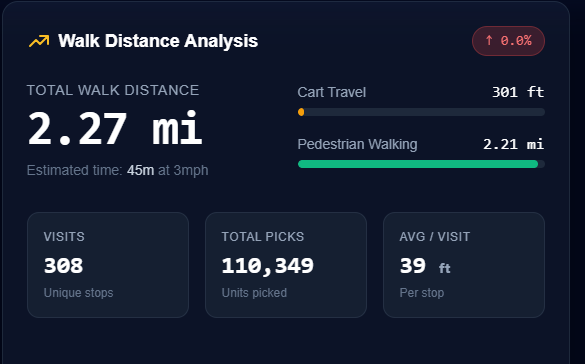
When the walk burden data is in front of you, three things become clear that spreadsheets hide:
Cold-zone bays stop hiding. Medium-velocity SKUs in poor locations create steady travel waste without ever cracking the top-pick report. They show up immediately in a burden view.
Prime real estate looks different. A high-pick SKU near the start point may already be doing its job. Moving it again might save almost nothing. The data tells you before you waste the move.
The conversation changes. Instead of "which SKU is busiest," the team asks "which location is charging us the most per pick." That is the question that drives real labor reduction.
This is also where the connection between planning and slotting becomes concrete. The walk burden data does not just identify a problem. It quantifies the tradeoff. You can see exactly how much daily travel is at risk if a constraint breaks a staging assumption, or how much labor recovery a slotting move actually delivers.
For more on how frequency and burden views tell different stories from the same data, see why your heatmap is lying to you.
The problem with starting your reslot at the top of the pick list
The most common slotting review mistake follows directly from the planning mistake: the team pulls a list sorted by pick count and works from the top.
Your #1 mover has been noticed. Managers see it. Supervisors see it. Whoever did the last review saw it. Because of that, high-velocity items tend to get reasonable placement over time, even informally. When you move them, the available savings per pick is often small.
A mid-velocity SKU sitting 90 feet from parking, picked 300 times a day, with a clear bay available at 15 feet, creates 300 x 75 feet = 22,500 feet of daily savings. That is more than most top-mover moves deliver, at a fraction of the disruption.
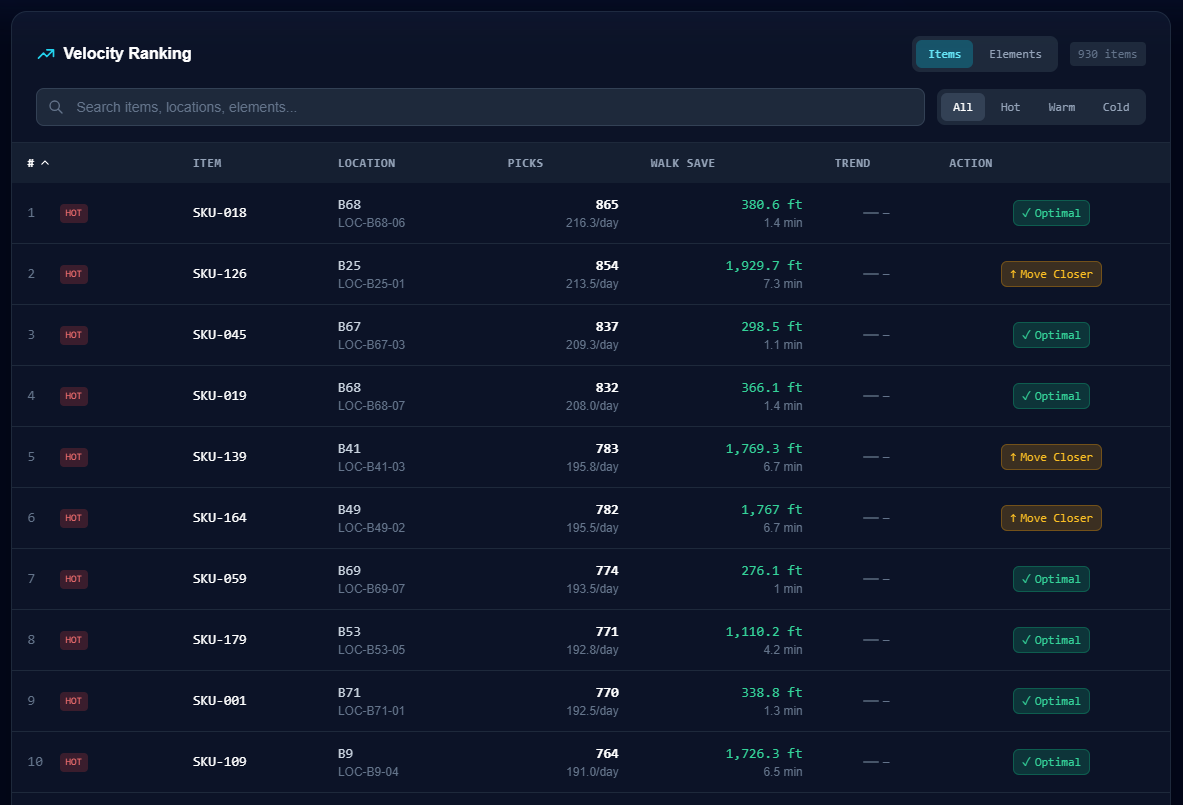
The velocity ranking view shows this directly. ABC tiers by pick frequency are useful context. The walk distance column next to them is where the actual opportunity lives. A C-tier SKU in a terrible location often outranks an A-tier SKU that is already well-placed.
For a deeper look at why reslotting priority should be built on savings, not volume, see why reslotting your top SKU often saves zero feet.
Where the old way breaks down
The standard workflow is a spreadsheet export, a manual sort, a walkthrough conversation, and then someone makes a list of moves. Sometimes that list gets executed. Sometimes it does not. Rarely does anyone calculate the actual daily walk savings before the move happens.
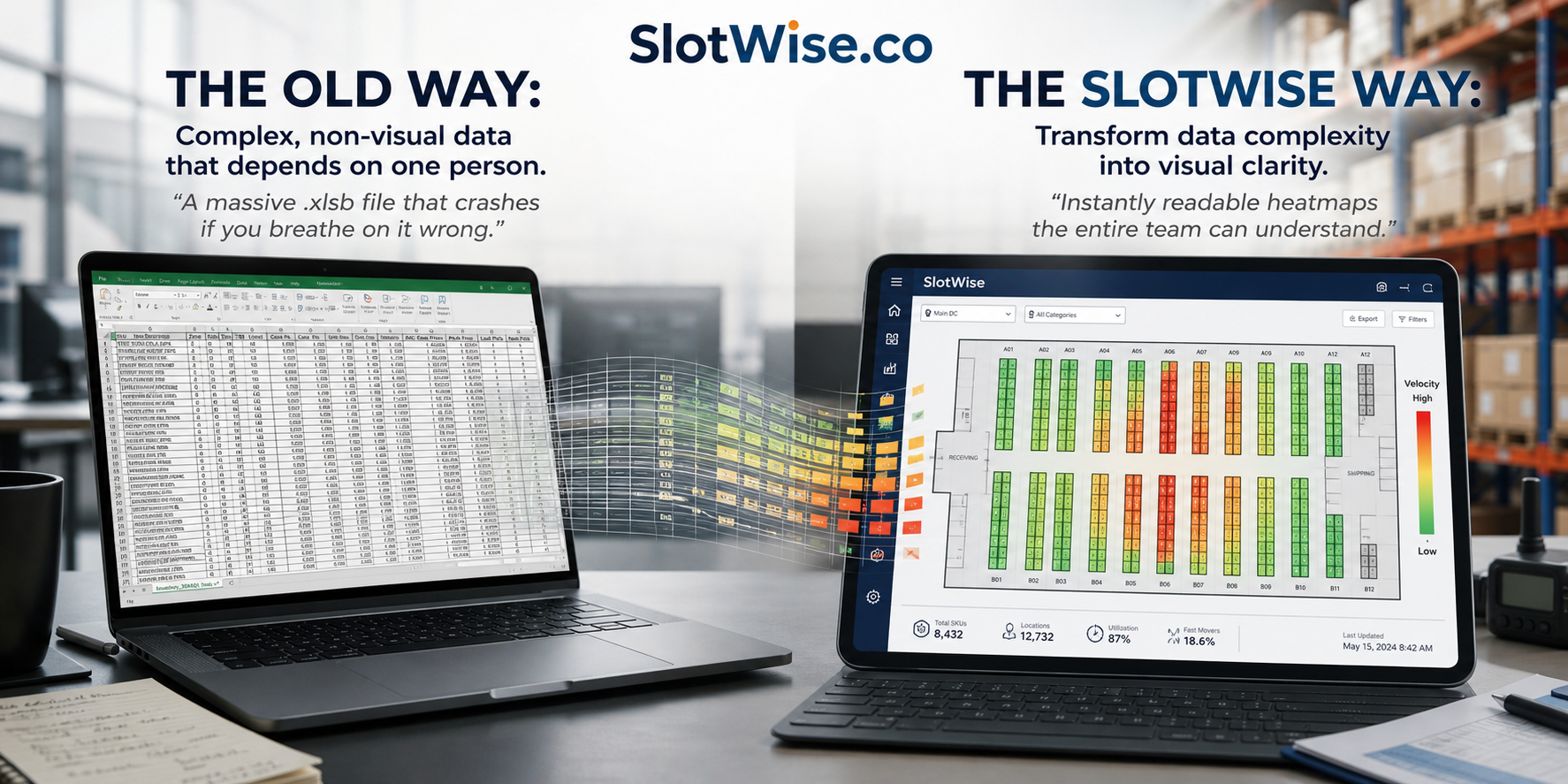
The problem with the spreadsheet approach is not that it uses a spreadsheet. It is that the spreadsheet cannot see the layout. Two SKUs with the same pick count have completely different labor costs if they sit in different parts of the building. Distance from parking, cross-aisle access, location type, available adjacent bays: none of that lives in the export.
Where SlotWise fits into this
SlotWise is built for the operating layer where planning tradeoffs show up as real labor costs.
The heatmap connects pick activity to layout geometry so you can see walk burden by location, not just volume by SKU. The velocity ranking surfaces which items are in the wrong place for the work they create. And the optimization queue builds the priority list automatically: picks x available savings per pick, filtered by location type so the recommendations are actually executable.
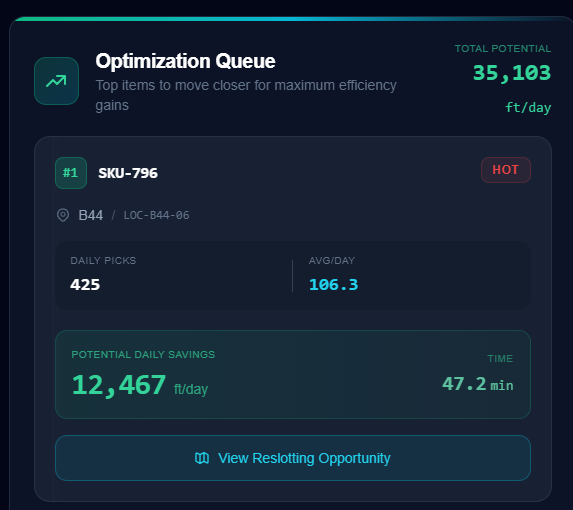
That last part matters. A list of 50 recommendations you have to manually filter is not saving time. It is creating work. A shorter list of moves the floor can actually execute, ranked by daily savings, is where the labor impact shows up in the same week.
The other thing the data makes visible is the planning fragility question. When you can see which locations are carrying the most unnecessary travel, which SKUs create burden disproportionate to their velocity, and where capacity gets tight under volume swings, the survivability questions become answerable with data rather than gut feel.
Which constraint will break first if volume shifts? The walk burden data tells you. Which tradeoff is least damaging today? The optimization queue tells you. Which move reduces risk without creating a new problem somewhere else? That is the conversation the data enables.
The takeaway
A plan that only works under perfect conditions is not a warehouse plan. It is a best-case scenario.
The better plan makes the tradeoff visible before the shift pays for it. It names the assumption that is carrying the plan, knows what it costs when that assumption breaks, and has a clear answer to which inefficiency the operation can absorb today.
If your floor is already choosing between space, travel, handling, timing, and labor on the fly, the next step is not to pretend one of them can disappear. The next step is to measure which one is costing you the most, make that cost visible before the wave releases, and decide whether that tradeoff is still the one you want to make.
That is the difference between optimizing for perfect conditions and planning for the floor you actually have.